Event Summary: Modern AI for a Better World
AI is becoming ubiquitous across the world, touching virtually all aspects of life. Whilst the exponential growth in the capability of AI is undoubtedly providing additional speed and convenience for humanity in the tasks it performs, there is an increasing need to consider the drawbacks associated with these tools. This event offered attendees a chance to hear evidence regarding the current and potential future socioeconomic impacts of AI, as well as discussions regarding how we can ensure any negative impacts are minimised.
This event was kindly sponsored by the AI SIG Sponsor, Appleyard Lees and generously hosted by Kadans Science Partner.
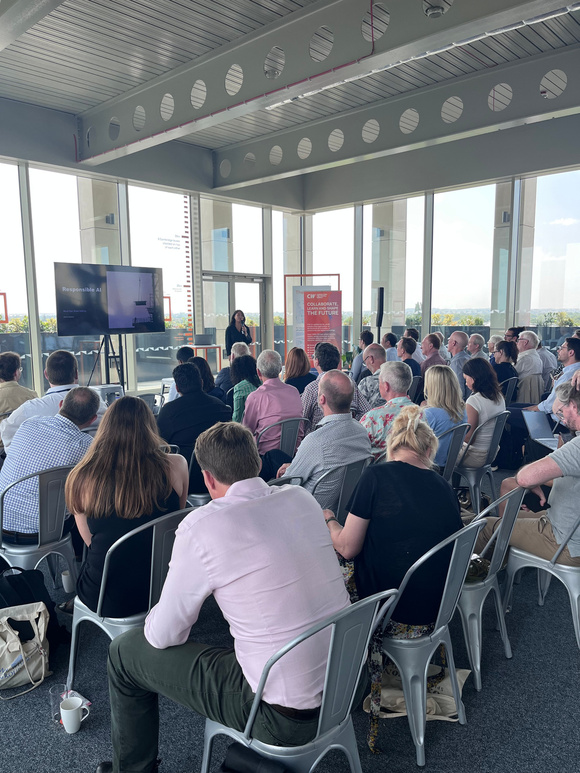
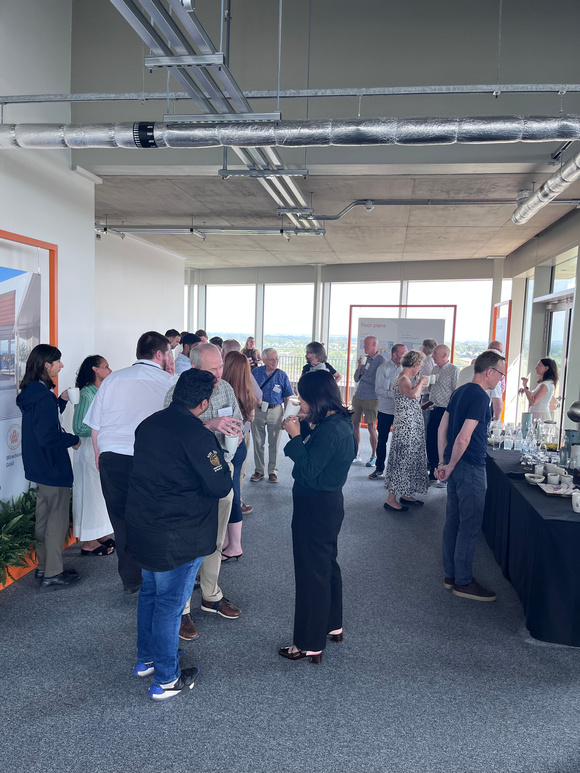
The first session of the day began with welcomes and introductions from Michaela Eschbach (Cambridge Wireless), Katie Nelson (Kadans Science Partner) and AI SIG Champion Peter Whale (Founder and CEO of Vision Formers). Peter also acted as chair for the day.
The first talk was given by Dr Mark Levy (Appleyard Lees) who offered a quick insight into the challenges of protecting intellectual property relating to AI innovations, particularly relating to the presence of the crucial “technical effect” of an invention needed to successfully obtain patent protection. Keeping with the theme of the event, this talk also considered whether AI innovations which have a positive impact on humanity (e.g. early detection of diseases, automated management of medication doses, and automated control of machinery in dangerous environments) are inherently more patentable.
This was then followed by a presentation by Professor Yonghong Peng (Deputy Dean for Research and Innovation, ARU) on the concept of “Institutional Intelligence,” and providing a roadmap to achieve this. Professor Peng illustrated that this concept can be used to achieve a framework for aligning people, data, and AI to achieve meaningful societal benefit by providing a joint approach for human and AI development. In this manner, it is envisaged that a symbiotic relationship between humans and AI can be achieved in workflows in order to close an estimated £400 billion skills gap. By building understanding of how AI is implemented and ensuring trust in its capabilities, Professor Peng illustrated that this could lead to faster decisions and enactment of those decisions, leading to a societal and competitive advantage.
Maxine Setiawan (Responsible AI UK Tech Lead – Global Responsible AI, Accenture UK) then provided an insightful talk regarding the responsible use of AI, intriguingly titled “Move Fast, Break Nothing.” This presentation began with a stark reminder that just because AI is in theory emotionless, it can still demonstrate inherent biases, with a case study presented which highlighted an inherent racial bias when predicting rates of criminals reoffending following release. However, it was noted that the use of AI cannot simply be removed since no matter where people sit in the organisation there is something they can bake into their everyday that will support them to be making the right decisions. Maxine then provided the insight that whilst governance and compliance can be implemented at a regulatory level, this should represent the minimum standard that companies should meet, with further controls ideally put in place to prevent reputational damage and to capture the inherent value of the implemented AI. As Maxine suggests, it is important to have sufficient control and knowledge throughout an organisation to be able to know you have the right brakes when you need them.
After a short break, the second session began with Edward Hall (Director, OppiSec Ltd) discussing the challenges that AI introduces within the technology space and beyond, and how we can embrace AI's potential while preserving trust, accountability, human agency and the values that underpin a secure and resilient future. A key theme of this presentation was the idea of assistance vs. control, and the importance of establishing boundaries regarding how much control we hand over to AI tools. In particular, it was highlighted that AI can often be overconfident and may not always be a trustworthy source of information. Further, it was noted that an uneven sense of accountability (humans taking credit when AI produces a good output, and disclaiming output where it is faulty) can effectively lead to a reckless use of AI tools which must be tempered to ensure that trust in AI tools is maintained. To this end, Edward took this accountability by revealing that his accompanying slides were generated with AI tools!
Dr Harry Cronin (Head of Applications – Standards and Science, Iprova) then provided a whistlestop tour of the Iprova platform; an AI implemented tool designed to complement rather than replace a human’s ability to innovate. This talk explored how effective human–AI collaboration can enhance invention while preserving patentability, and considers how advanced AI could form a new “invention layer” linking scientific discovery to real-world innovation. In particular, Iprova was explained as being a tool which could ascertain relevant concepts to a particular topic which may not be directly related to that topic (an example which was provided noted a link between eye movement and a corresponding noise being made in the ear), and then provide relevant information around these topics. As such, Iprova can help spark ideas by a user, without directly generating those ideas itself (e.g. by noting the link between eye movement and noise, and providing information to a human to allow them to develop innovations which exploits this link). This certainly illustrated how AI may be used synergistically with human ingenuity.
The final presentation was provided by Dr Simon Fothergill (Head of AI, Lucent AI), with Peter’s favourite talk title of the day – “Blessed Are They Who Have Nothing to Say and Cannot be Persuaded to Say It.” Dr Fothergill began by noting that AI is being used in a selfish manner, which is to say it is more connected than ever, but is being used less deeply. It was suggested that perhaps a better way of implementing AI is to take the approach that AI models should be more akin to corner shops rather than supermarkets, in order to understand narrow, yet wondrous, vignettes of our word-based world. He discussed a practical framework of metrics to measure against to help articulate what there is to model, how to model it and how to share this knowledge in a trustworthy way. Simon provided illustration of this approach with personal stories from his career so far, including within the extremes of sports, dangers of mental health and creativity of marketing.
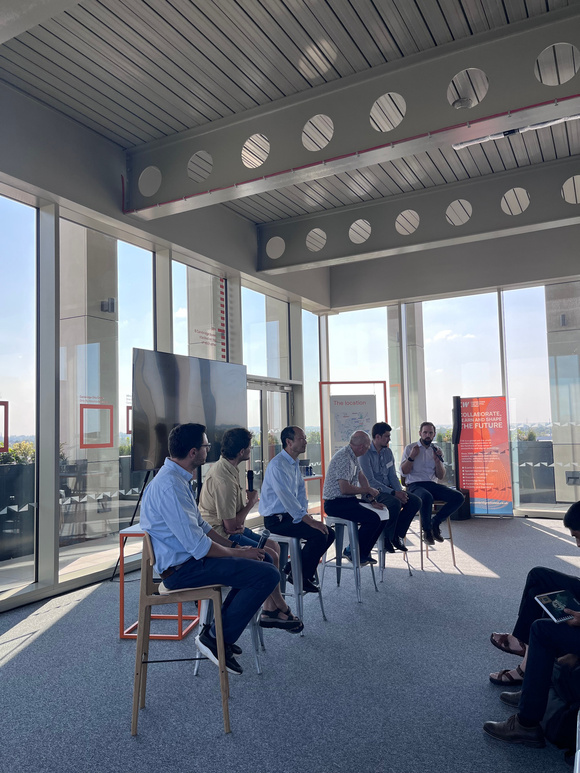
Panel Q&A
The event concluded with a question and answer session with several of the speakers from the day, chaired by Peter Whale. This session offered the audience a chance to follow up with further questions surrounding the themes of the day. This gave everyone a chance to learn from the speakers what they feel would represent a successful integration of AI into a modern world, as well as what AI has already specifically learned from them (in addition to whether each panel member says please and thank you to their smart home devices!).
Closing Remarks
The implementation of AI into more of everyday life is inevitable, and the impacts of this introduction must be taken seriously. This event has demonstrated that thoughtless implementation of these tool will lead not only to distrust of AI, but also may damage and restrict its usefulness. However, the presentations given during this event have served to highlight that this negative outcome is far from a certainty, and that a considered and measured approach to AI implementation can lead to a positive and prosperous future.
The Articifial Intelligence SIG is proudly sponsored by Appleyard Lees.